


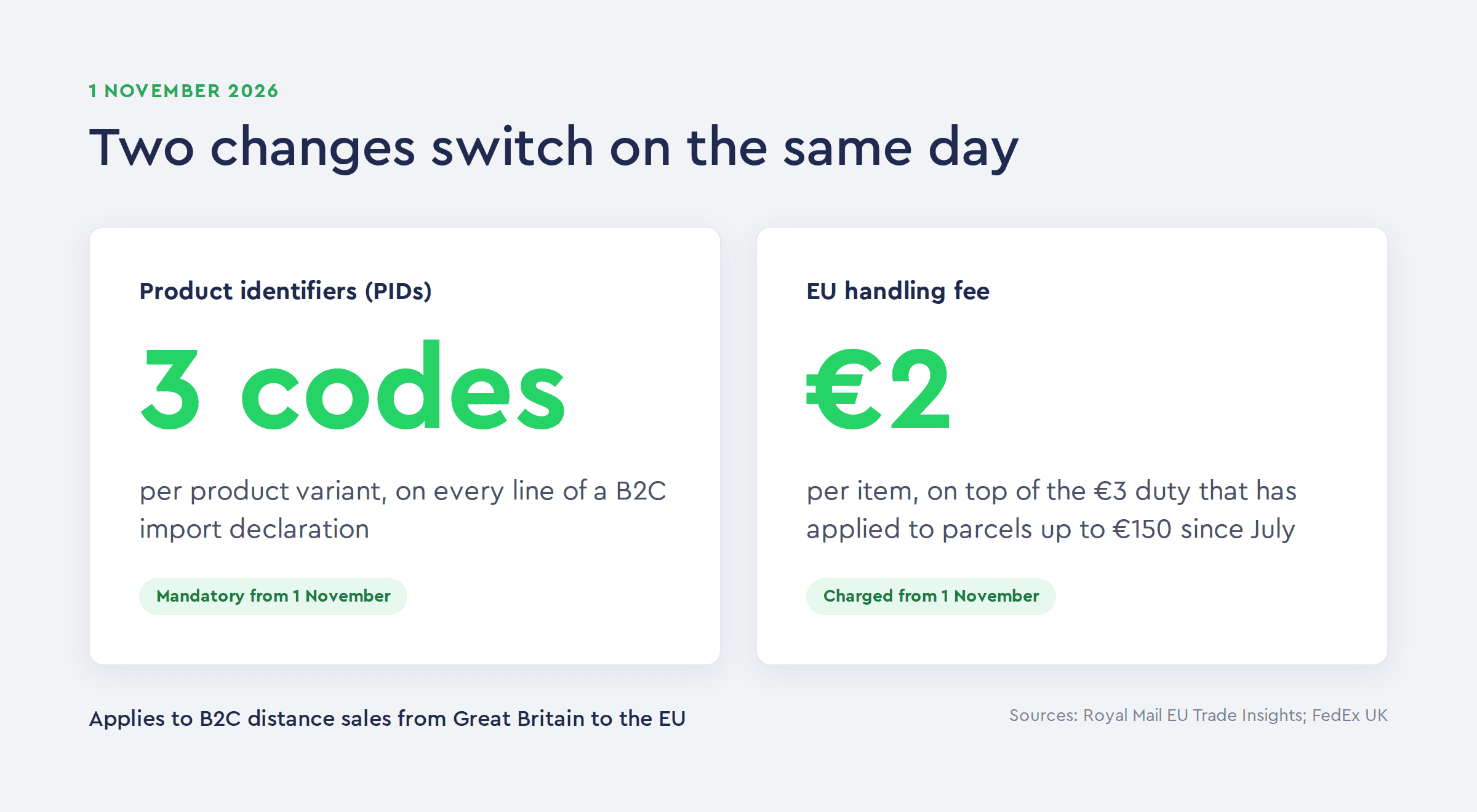
On Sunday 1 November, two EU customs changes switch on at once. EU customs product identifiers (PIDs) become mandatory on every B2C import declaration, and a new €2 Union Handling Fee is added to every distinct item in a parcel.
For an enterprise retailer shipping thousands of EU orders a day, PIDs are a product data project with a hard stop. It lands four weeks before Black Friday.
Here are the five things we’d want every UK logistics and eCommerce operations lead to have checked before then.
1. November is two changes, and both are about your data
From 1 November, B2C distance sales imported into the EU need product identifiers on each line of the customs declaration. FedEx’s UK guidance has recommended adding them since 1 July, ahead of enforcement on 1 November, so the last four months were the test window. From 1 November, a declaration without them is incomplete, and an incomplete declaration means a parcel that waits.
On the same day, the EU’s €2 handling fee starts. Royal Mail’s EU trade guidance confirms it has been published at €2 per line, applies to distance sales, and is charged on top of the €3 customs duty that has applied to low-value parcels since July. It applies to exports from Great Britain.
| Date | What changes | What it means for a UK retailer |
|---|---|---|
| 1 July 2026 | €150 duty exemption removed; flat €3 customs duty per item on B2C parcels up to €150. PIDs accepted voluntarily. US CPSC data required for regulated consumer products | Landed cost changed. PID data could be tested with no penalty |
| 1 November 2026 | PIDs mandatory on B2C import declarations. €2 Union Handling Fee per item | Missing PIDs stop the declaration. Cost per parcel rises again |
| 30 December 2026 | EU Deforestation Regulation applies to large and medium businesses | A due diligence (DDS) reference is needed for covered goods |
| 30 June 2027 | EU Deforestation Regulation applies to small businesses | Smaller suppliers in your chain will need DDS references too |
| 1 July 2028 | European Customs Data Hub expected; temporary €3 duty and PID measure due to be replaced | Build PID data into your product master now, so it's reusable later |
Three scope points trip people up. The rule covers B2C only: B2B imports follow normal customs rules, so your systems need to tell the two apart reliably. Guidance differs on parcels above €150, with some carriers applying PIDs at any value, so the safe plan is to send them on every B2C parcel. And it applies to goods moving from Great Britain. The UK government’s EU reforms page says guidance on Northern Ireland movements is still to come, so check those flows separately.
2. The three EU customs product identifiers sit in three different teams
Each PID is easy to define. The hard part is that, in most retail businesses, each one is owned by a different team and only one of them ever reaches your carrier today.
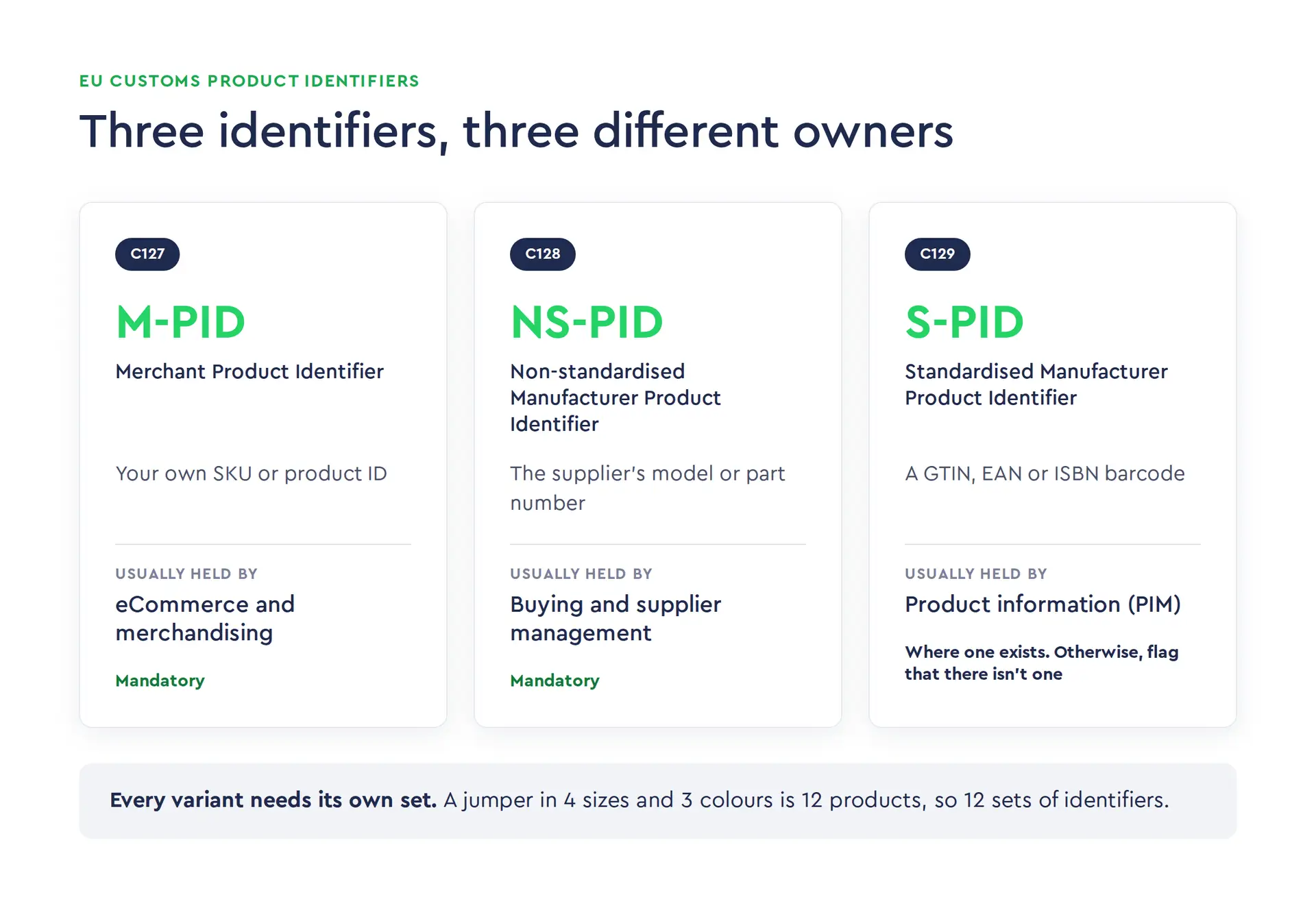
Not every product has a standardised identifier, and that’s fine, as long as your data says so. For now, most carriers simply ask you to state that there isn’t one: FedEx’s EU guide shows shippers entering “Standardised Product ID NO”. Customs records this as exception code Y081, and some carriers may ask for that code directly as their integrations develop. Either way, the preparation is the same: flag which products genuinely have no S-PID, rather than leaving the field blank.
Identifiers live at variant level. A jumper in four sizes and three colours is 12 products, each needing its own set. If you make your own products, your NS-PID can be the same as your SKU, which takes most of the pain out for own-brand ranges. The real work is concentrated in branded and third-party lines, where the NS-PID has to come from a supplier who may never have been asked for it.
3. Commodity codes now set the cost of every EU parcel
PIDs don’t replace commodity codes. A PID says which product is in the box. The commodity code, built on the six-digit Harmonized System (HS) codes, says how customs treats it, and HMRC’s guidance on commodity codes is the starting point for checking yours. Your customs declaration form needs both, on every line.
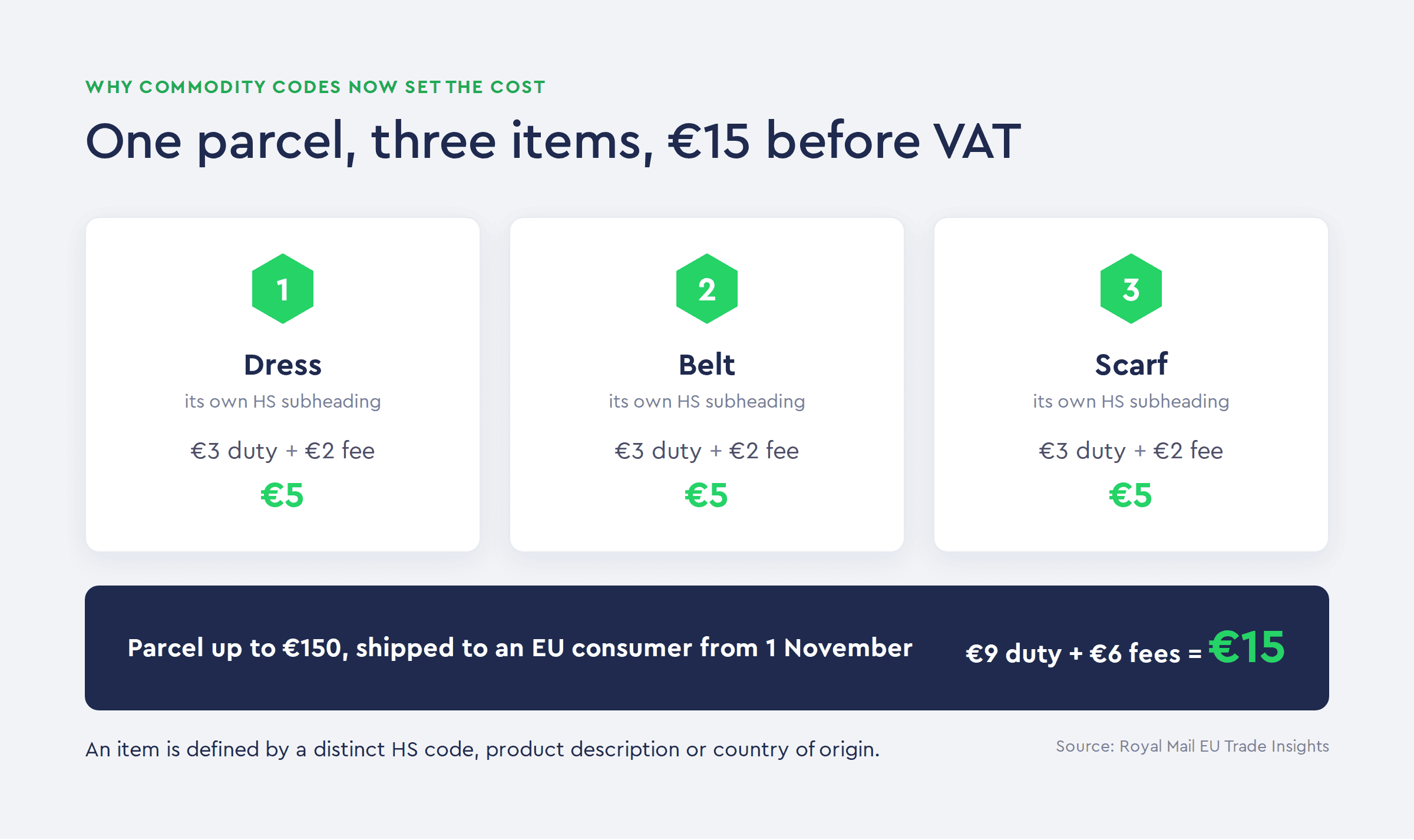
What’s changed is how much that tariff classification now costs you. The €3 duty and the €2 handling fee are both charged per item, and Royal Mail defines an item by a distinct HS code, a distinct product description or a single country of origin. Three different products in one parcel can mean three charges.
So a parcel up to €150 with a dress, a belt and a scarf, each with its own HS subheading, carries three items. From 1 November that’s €9 in duty plus €6 in handling fees, before VAT, on a single order. Some countries add their own charges on top: Royal Mail lists a €2 Italian fee from 1 October and a Romanian logistics tax of around €5. Above €150 the €3 flat duty falls away and normal customs duties and taxes apply, but the handling fee still covers distance sales.
That changes the role of product data. A commodity code that’s too generic, or a variant classified differently from its siblings, now changes the bill on every parcel it touches. And because customs can use a PID to find every other shipment carrying the same product, one weak record can follow every parcel of that product across your EU flow.
4. Every carrier asks for the same three codes in its own way
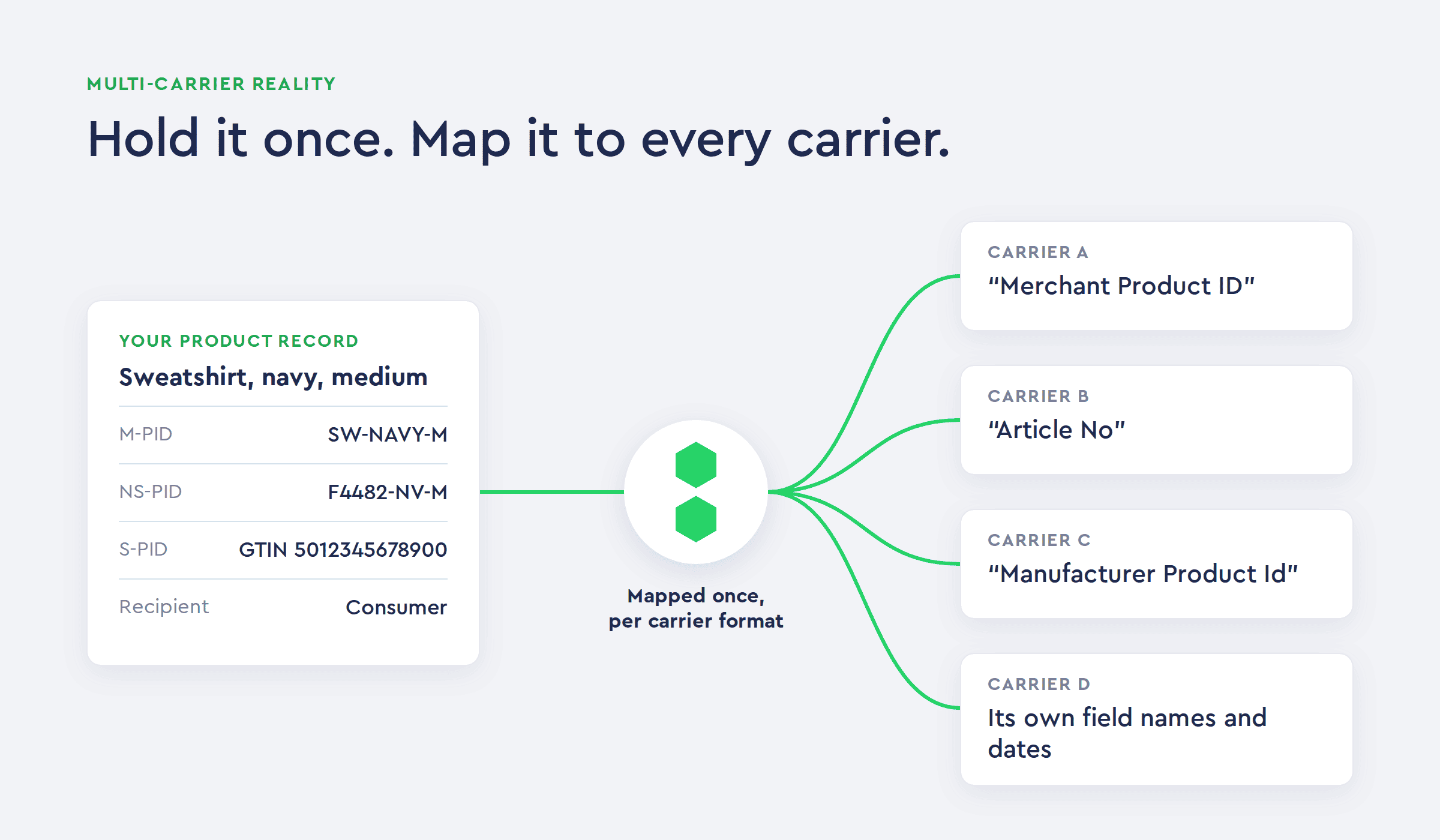
The EU defines three identifiers. Your carriers don’t all use the EU’s names for them. The same merchant identifier can be a “Merchant Product ID” in one carrier’s API and an “Article No” in another’s, and the manufacturer identifier is labelled differently again from carrier to carrier.
Carriers are also switching on PID transmission to their own timetables. If your EU volume is split across a postal service, two couriers and a DDP partner, you’re managing four integrations, four field specs and four go-live dates, all feeding from the same product record.
The B2C flag matters just as much. PIDs, the €3 duty and the handling fee all hang off whether the recipient is a consumer. A business order sent without a reliable recipient type can end up declared as B2C, with the extra data and cost that brings. A trade customer’s parcel held for missing consumer data is an avoidable conversation with an account you care about.
The practical answer is to hold each identifier once, at variant level, in your product master, and let your delivery management layer map it to each carrier’s format. Re-keying the same code into several carrier portals is how errors multiply at volume.
5. Your real deadline is your peak change freeze
1 November is a Sunday. Black Friday is 27 November. For many enterprise retailers, system changes stop well before either date, so any change to product feeds, order exports or carrier integrations has to be live and tested before your freeze starts.
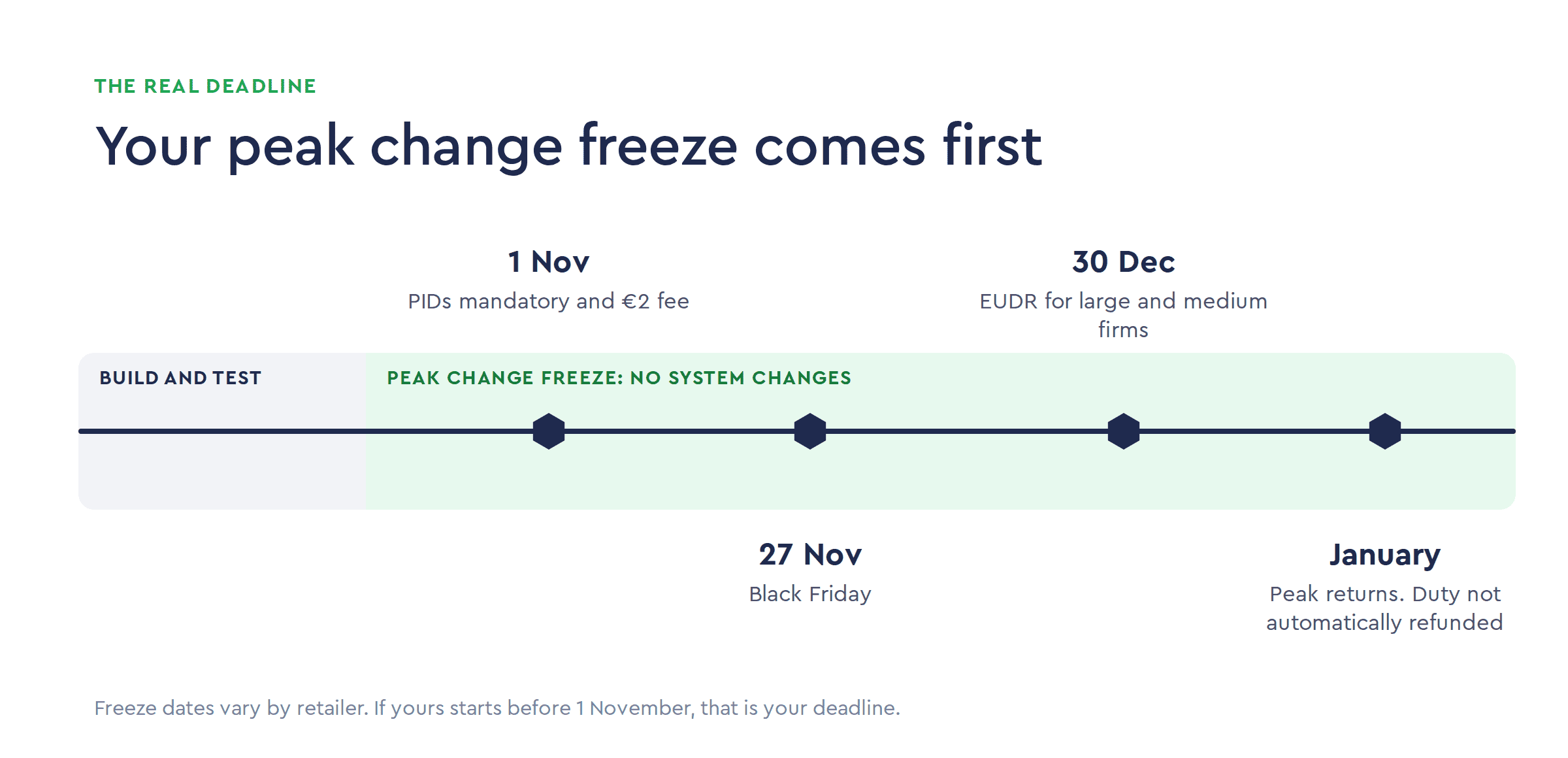
The first weeks of the new rules will also be your busiest EU shipping weeks. Any data gap shows up as held parcels and a spike in “where is my order?” contacts at exactly the point your customer service team has the least spare capacity.
Two knock-on effects are worth briefing your teams on now:
- • Customers paying on the doorstep. If you ship delivered duty unpaid, the carrier will ask your customer to pay the duty and handling fee before handing the parcel over. More EU orders now carry a charge, so expect more refused deliveries unless you price it in up front.
- • Returns. Royal Mail notes that duty on B2C returns isn’t automatically refundable once goods are released into free circulation. With peak returns following in January, check how your returns process and customer refunds treat it.
What to do before 1 November
With the time left, focus on the products that carry most of your EU volume and work outwards.
- 1. Map your EU B2C flows by carrier, service and declaration route, including IOSS. Keep B2B and Northern Ireland flows separate.
- 2. Export your EU-bound catalogue at variant level and check every line for an M-PID, an NS-PID, and either an S-PID or a clear flag that the product doesn’t have one.
- 3. Chase suppliers for missing NS-PIDs, starting with your top EU sellers. This has the longest lead time of anything on the list.
- 4. Check commodity codes and country of origin per variant. They now set the per-item duty and handling fee as well as the classification.
- 5. Confirm every order carries a reliable recipient type, so business orders stay out of B2C rules.
- 6. Test end to end with each carrier before your peak change freeze, using real orders.
- 7. Decide who pays duty and fees, and brief customer service on doorstep charges and returns.
- 8. Name one owner for EU customs data, and review holds and broker queries weekly through peak.
How Scurri helps
We’ve added the new customs fields across the Scurri platform so you can send PID data once and let us map it to each carrier.
- • New fields: Manufacturer Product ID (NS-PID), Standardised Product ID and Standardised Product ID Type (S-PID), and Recipient Type (consumer or business), so B2B shipments are handled correctly. Your existing SKU already covers the M-PID.
- • Every way you send data: the new fields are live in the UI, in an updated CSV importer with searchable column mapping, and in a new version of the Consignments API. You can test in Sandbox before switching over in production.
- • Carrier mapping: we’re mapping the new fields to each carrier’s requirements ahead of 1 November, starting where carriers have confirmed their specs. You send the data once; we handle each carrier’s format.
- • Pre-built integrations: if you connect through Shopify, Brightpearl, Peoplevox or a similar platform, there’s no immediate action. We’re assessing automatic import of the new fields from connected platforms.
- • Beyond the EU: the same release carries fields for US CPSC certificate data (Certifier ID, Product ID and Version ID) and the EU Deforestation Regulation DDS reference.
If you’re already a Scurri customer, check your product data for every variant, test it in Sandbox now, and contact support@scurri.com when you’re ready to move to the new API version. If you’re reviewing how your EU deliveries will hold up through peak, talk to our team.
This article is general guidance, not legal or tax advice. Customs rules and carrier requirements are still being finalised in places, so confirm the detail for your business with your carriers and customs adviser.