




Delivering on the Promise: How Leading Brands Build Loyalty Through Reliable Delivery
For most eCommerce retailers, the “moment of truth” often happens after the sale. It happens when a customer anticipates a delivery, follows tracking updates, expects the product on the promised day, and experiences whether the final mile lives up to the brand’s reputation.
Miss here, and retailers risk undermining trust. Deliver well, and it’s possible to reinforce brand promise, deepen loyalty, reduce post-purchase anxiety, and even turn delivery into a competitive differentiator.
As a result, here at Scurri we’ve seen a significant increase in the amount of our retail customers who are actively using our reporting dashboards to assess whether or not they are keeping their delivery promise.
When working with retailers who are seeking to improve the delivery promise, the questions I encourage them to ask are:
- 1) How do we check whether the delivery promise is being met – at every stage?
- 2) How do we determine what should be promised – so it’s realistic, inspiring, aligned with operations?
- 3) What tools or systems help bridge any gap between what you say, what you can deliver, and what customers perceive?
In this article I’ll explore key lessons I’ve learned from dealing with retailers as they seek to improve the delivery promise.
Why the delivery promise matters more than ever
A Salesforce UK study shows that 71% of consumers say they will remain loyal to eCommerce companies that deliver faster service and 61% expect companies to use up-to-date information in customer interactions.
Furthermore, customers are extremely interested in hearing about updated in relation to their delivery. Scurri’s own research of 1,000 UK consumers reveals that 81% of customers are more likely to open delivery update emails than any other type of communication from a retailer.
Also, research shows that accurate delivery date promises are critical: promising too early (over-promising) leads to churn when expectations aren’t met; promising too conservatively may lose orders.
The balance of accuracy vs optimism matters – and typically the first step our team will take with a retailer who is keen to improve their delivery promise is to firstly check whether their current delivery promise is being met.
How to check whether the delivery promise is being met

To manage this well, you need reliable data, clear KPIs, monitoring and closed feedback loops. That’s how reporting dashboards play a key role in determining the delivery promise. Here are the key dimensions to track:
1. Transit Time vs Promised Time
Start by comparing actual delivery times with what was promised at checkout or in customer confirmations. Tracking this across carriers, destinations, and time periods helps you identify gaps between expectation and performance. Customers rarely notice when things go right, but they always remember when deliveries arrive late. Understanding where delays occur enables you to refine promises or address the operational causes.
2. Exception Rates
Measure how often deliveries encounter issues such as delays, mis-scans, reroutes, or lost parcels. Analysing where and why these exceptions happen, by region, carrier, or fulfilment centre, gives you the data needed to fix weak links. Exception rates act as an early warning system for broken promises and dissatisfied customers.
3. Carrier Performance and Reliability
Not all carriers perform equally, and even the best ones can vary by geography or product type. Monitoring on-time delivery, damage rates, and how carriers handle exceptions gives you insight into which services are helping you keep your promises and which are increasing your exposure to risk. Use this data to make smarter carrier selections or negotiate service-level improvements.
4. Tracking Visibility and Communication
A delivery that is on time but poorly communicated still feels unreliable to the customer. Evaluate how accurate and timely your tracking updates are, how quickly customers receive them, and whether your tracking pages are branded and consistent. Transparent communication not only reduces “Where Is My Order?” enquiries but also reinforces brand trust throughout the journey.
What to promise - balancing ambition with reality

Occasionally I’ve worked with retailers who struggle to determine what their delivery promise should be. I always advise that promising too much can lead to mismatched expectations, but not promising an attractive enough delivery can lead to competitors taking the lead.
Here’s a few tips for balancing the delivery promise:
Understand your operational constraints
Review carrier performance, transit times by region, seasonal patterns. Where are delays likely (remote postcodes, customs, weather, capacity)? When demand surges, can your fulfilment & last-mile network scale?
Collect historical data
Past delivery times, exception rates, etc. Use this data to set realistic estimates, then build in buffer-time where you see higher variance.
Urban vs rural locations have different logistics realities. Some product lines may justify faster promises (with higher cost) if you can reliably execute.
Be transparent in checkout & confirmation
Show estimated delivery windows (not just dates), differentiate between standard / express / premium shipping. Disclose known potential delays in certain locations. Let customers see choices. If you have “delivery by X date” or “delivery in Y days”, clearly show what each means and how delays are communicated.
Communicate proactively
If a delay is likely, inform customers early with branded tracking updates. If a delivery is going to be late, offering options (reroute, reschedule) or compensations can mitigate disappointment and preserve loyalty.
How Scurri helps UK brands bridge promise & delivery
When I first began working at Scurri, our main focus was connecting all aspects of delivery to ensure thorough, frictionless delivery.
However in recent years, we’ve levelled up our reporting capabilities and our post-purchase communications offering so that retailers can improve their performance and their customers can have an enhanced delivery experience.
Essentially, there are now three ways that Scurri can help with the delivery promise:
1) Improving operations with Scurri Connect
Centralised shipping-&-delivery control: With Scurri Connect, you can connect to 1,500+ carrier services, automate the selection of carriers using rules (based on cost, reliability, speed, region etc.), generate carrier-approved labels, and ensure valid data for cross-border/customs.
Real-time tracking & monitoring: Every shipment’s status, carrier performance, and customer tracking info are unified in the platform. This gives you visibility into what’s happening vs what was planned (or promised).
Rules Engine: To define carrier selection logic, fallback options, prioritisation of speed vs cost or reliability. This is critical for ensuring that promises made to customers are grounded in live operational capability.
2) Providing carrier and delivery performance with our next-gen reporting dashboards
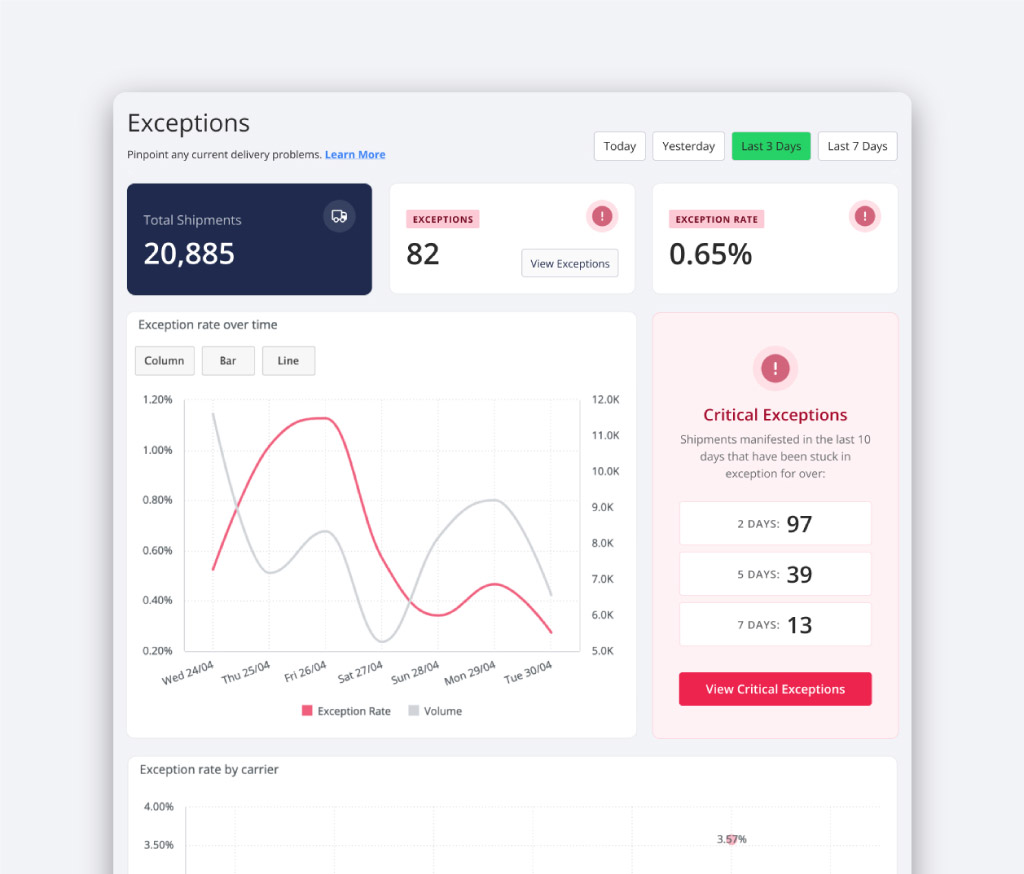
Scurri’s Reporting Dashboards give brands the visibility they need to monitor delivery performance and ensure promises are being met. The dashboards combine high-level overviews with granular insights. Our suite of reports include four main reports.
Our Exceptions Report helps retailers identify delivery problems early to limit the impact to customers, flagging delivery issues early through detailed exception reporting and helping identify where service performance may be at risk.
Our Transit Time Report highlight where shipments take longer than expected, allowing teams to refine or recalibrate delivery promises.
Our Tracking Report helps retailers to comprehensively monitor their shipment status.
Our Volume Report provides retailers with comprehensive insights into the volume of manifested shipments.
3) Providing a retailer-branded customer delivery experience
A brand can meet all their delivery targets at each stage of delivery – but if they fail to communicate the delivery stages effectively, this can result in a perceived negative delivery experience due to mismanagement of expectations.
That’s why it’s critical to provide branded tracking communications that keep customers informed and ensure the retailer brand is front and centre during a time of peak engagement.
Our own research report – The Future of Delivery and Post-Purchase Revealed – found that 77% of customers have more confidence in tracking updates if the tracking email is sent from a retailer.
Our post-purchase software Scurri Track Plus helps retailers send branded tracking emails, manage expectations with an estimated delivery date and provide a branded tracking timeline.
The real work of keeping of keeping the delivery promise lies in fulfilling the order on time – but keeping the lines of communication open during delivery is how leading brands reap all the benefits.
Putting it all together: A roadmap for UK retailers

We’ve established that taking control of the delivery promise first involves assessing what you’re capable of delivering, then defining your promise and most importantly following through with continuous assessment.
Now, here’s a step by step approach that our team typically recommend our retailers follow:
1) Baseline Assessment
2) Benchmarking and Promise Definition
3) Operational Strengthening and Carrier Strategy
Use Scurri Connect to manage your carrier contracts and services through data-driven insight. Where performance is weaker, switch or add carriers to improve reliability. The Rules Engine within Scurri Connect allows you to automate carrier selection, ensuring that the most dependable partners handle specific product types or regions. It is also essential to make sure your fulfilment and last-mile operations have the capacity to deliver on promises, particularly during peak periods.
4) Customer Journey Design and Communication
5) Continuous Monitoring and Feedback Loop
6) Using Delivery as a Loyalty and Differentiation Tool
Promote your delivery reliability as a core part of your brand’s value proposition. Customers who choose premium brands expect consistency and trustworthiness, and delivery is an important proof point. You could also consider premium delivery options that are faster, more flexible, or higher touch as part of a loyalty programme.
Finally, communicate your delivery performance proudly in marketing materials and customer updates, for example by sharing metrics such as “99% of all orders delivered on time in the past 12 months.”
Conclusion: When done right, the delivery promise is worth more than the sum of its parts
I tell retailers all the time that making good on your delivery promise is completely possible – but there’s no quick trick to getting the delivery promise right; instead, it’s a series of steps and a journey of continuous improvement.
It takes evaluation, analysis and a continued focus. Take the eye off the ball, and retailers risk disappointing customers through a broken promise – or failing to win customers over due to a less than competitive offering.
When all of the components are in place, however, the delivery promise can be met and keeping it can fundamentally enhance the customer’s perception of the brand. Do it right, and – like many Scurri customers – you’ll not only see your Trust Pilot rating ascend – you’ll also see an increase in repeat orders from customers who simply love to order from you.
If you’d like to chat to any of our team about how our tools can help you transform the customer delivery experience and meet the delivery promise, get in touch and we’ll be happy to help.